
Large Uterine Tumour: Is Laparoscopic Surgery Possible?
Most large uterine tumours are fibroids, and in experienced hands many can be operated on laparoscopically. However, keyhole surgery is not suitable for everyone.

In this article 5 sections
Even when a uterine tumour is large, laparoscopic (keyhole) surgery is possible in many cases. With modern equipment and an experienced laparoscopic surgeon, quite large tumours can be removed through a few small holes instead of a big cut in the abdomen. However, the doctor decides which approach is safest after looking at the tumour’s size, number and position and at the patient’s overall health. In the video, Dr. Sharmin Afroz briefly explains this topic.
01What a uterine tumour really is
The most common tumours of the uterus are called fibroids, or myomas. They grow from the muscle of the womb and are almost always non-cancerous (benign). Fibroids can range from the size of a pea to very large, and there may be one or several. Not every fibroid needs surgery; if there are no symptoms, regular monitoring is often enough.
02When surgery is needed
- Heavy menstrual bleeding causing anaemia
- Lower abdominal pain, heaviness or swelling
- Pressure on the bladder or frequent urination, constipation
- Difficulty conceiving or repeated miscarriage related to the fibroid
- A tumour that is growing quickly
Surgery can be of two types: removing only the fibroids and keeping the womb (myomectomy), or removing the womb (hysterectomy). Both can be done laparoscopically in suitable cases.
03What decides whether laparoscopy is possible for a large tumour
- Size and number: very large or numerous fibroids can make the operation more complex and longer.
- Position: which layer and side of the womb the fibroid lies in matters when choosing the method.
- Suspicion of cancer: if ultrasound or MRI shows anything suspicious, open surgery is generally considered safer.
- Your health: previous abdominal surgery, anaemia and other conditions are taken into account.
- Surgeon’s skill and hospital facilities: laparoscopic surgery for large tumours needs special training and equipment.
Sometimes the doctor may give medicine for a period before surgery to correct anaemia or shrink the fibroid. During the operation, it may occasionally be necessary to convert to open surgery for safety.
04Benefits and risks of laparoscopy
Compared with open surgery, laparoscopy usually means less pain, less blood loss, a shorter hospital stay, a quicker return to normal activities and smaller scars. However, like any operation, it carries risks such as bleeding, infection, complications of anaesthesia and, rarely, injury to nearby organs. Discuss these openly with your doctor before surgery.
When to see a doctor
If a uterine tumour is found, consult a gynaecologist and laparoscopic surgeon. Go to hospital promptly if you have any of the following:
- Heavy bleeding during or between periods, or passing large clots
- Dizziness, palpitations or feeling faint
- Sudden severe lower abdominal pain, especially with fever
- Being completely unable to pass urine
- A fibroid growing, or new bleeding, after the menopause
Q & A
Frequently asked questions
No, most uterine tumours are fibroids, which are not cancer. Proper tests are still important to confirm this.
There is no fixed limit; it depends on size, position, number and the surgeon's experience. Your doctor will advise after reviewing your scans.
Recovery is usually much quicker than after open surgery, but the exact time depends on the type of operation and your health.
No, small fibroids without symptoms often only need regular monitoring. Treatment is needed when there are symptoms or complications.
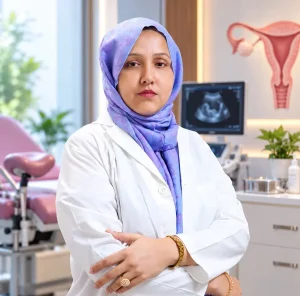
Article & video by
Dr. Sharmin Afroz
Obstetrics, Gynaecology & Infertility Specialist and Laparoscopic Surgeon
Assistant Professor, Department of Obstetrics & Gynaecology, Anwer Khan Modern Medical College & Hospital.