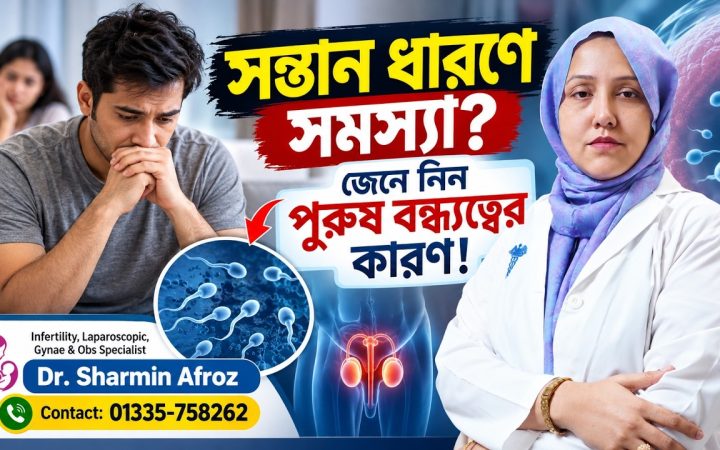
Male Infertility: Finding the Cause, Tests and Treatment
Male infertility can stem from problems with sperm production, hormones or the passage of sperm, and investigation usually begins with a semen analysis.

In this article 5 sections
The main causes of male infertility are low or poor-quality sperm production, hormonal problems, a blockage in the passage that carries sperm, swollen veins in the scrotum (varicocele), certain infections and genetic factors, and lifestyle influences such as smoking. Investigation usually starts with a semen analysis, and treatment is chosen according to the cause. In the video, Dr Sharmin Afroz briefly explains this topic. This article sets out the steps of testing and treatment in simple terms.
01Why both partners should be tested
In our society the woman is often blamed when a couple cannot conceive, but this is not right. In many couples there is a male factor, and sometimes both partners are affected. So if pregnancy has not happened after a year of trying (six months if the woman is over 35), both partners should begin tests together. Initial testing for men is simple, painless and relatively inexpensive.
02Semen analysis
This is the first and most important test for male infertility. It looks at sperm count, how well the sperm move (motility), their shape (morphology) and the volume of semen. To get an accurate result:
- You are usually asked to avoid ejaculation for 2 to 7 days beforehand; follow the laboratory’s instructions.
- The sample is collected in a clean container provided by the laboratory and handed in within a set time.
- Sperm quality can dip for a while after a fever or illness, so let your doctor know.
- Do not lose heart over one abnormal report; because sperm quality varies, the test is usually repeated after a few weeks.
03Other tests that may be needed
- Physical examination: to check testicular size and look for a varicocele or other problems.
- Hormone tests: to measure the hormones involved in sperm production.
- Scrotal ultrasound: to confirm structural problems or swollen veins.
- Genetic tests: in some cases where there are no sperm or very few.
- Infection tests: if there are signs of infection in the urine or semen.
04Treatment based on the cause
- Lifestyle changes: stopping smoking and tobacco, avoiding alcohol, managing weight, exercising regularly and keeping the testicles away from excess heat. Sperm take around three months to develop, so changes take time to show results.
- Treating hormones and infection: if a specific hormone deficiency or infection is found, your doctor will prescribe treatment accordingly.
- Surgery: in selected cases, varicocele repair or surgery to clear a blockage may be considered.
- Assisted reproduction: depending on sperm quality, IUI, IVF or ICSI may be offered. If there are no sperm in the semen, it is sometimes possible to retrieve sperm directly from the testicle.
An important caution: taking testosterone or steroids on your own for strength or bodybuilding can severely reduce sperm production. Do not take medicines based on advertisements.
When to see a doctor
- If your partner has not conceived after a year of regular trying (six months if she is over 35)
- If you have a history of testicular injury, surgery, mumps or cancer treatment
- If you notice swelling, a lump or heaviness in the scrotum
- If you have sexual or ejaculation problems
- Go to the emergency department without delay for sudden severe pain in the testicle
Q & A
Frequently asked questions
Usually 2 to 7 days without ejaculation is advised. Follow your laboratory's specific instructions.
No. Sperm quality varies over time, so the test is usually repeated after a few weeks to confirm.
New sperm take around three months to develop, so it takes at least a few months to see an improvement.
In some cases sperm can be retrieved directly from the testicle and used with ICSI. A specialist will assess your situation and explain the chances.
Article & video by
Dr. Sharmin Afroz
Obstetrics, Gynaecology & Infertility Specialist and Laparoscopic Surgeon
Assistant Professor, Department of Obstetrics & Gynaecology, Anwer Khan Modern Medical College & Hospital.